


Every turnaround starts long before the first flange is opened. Months ahead, work preparers build hundreds of work packages: what needs to be done, in which order, by whom, with which materials and how many hours it will take. It is skilled work, and it is also some of the most repetitive work in the whole organisation.
Ask a work preparer where the hours actually go, and the answer is rarely the thinking. It is the searching. Which package did we use the last time this exchanger was opened? Where is the template for a valve overhaul in this unit? What was the function location again, and which tag numbers belong to it? How many hours did it really take, and which materials were ordered? The knowledge is there, but it is scattered across old packages, spreadsheets, the ERP and people's memories. Finding it, copying it and adjusting it takes up most of the day.
Start from what you already have
AI Work Preparation turns that around. Instead of starting with an empty template, you start with something you already have. In most cases that is an existing work package: last year's package for the same equipment, or a package for a similar job somewhere else on site. It can also be the technical drawings, such as isometrics.
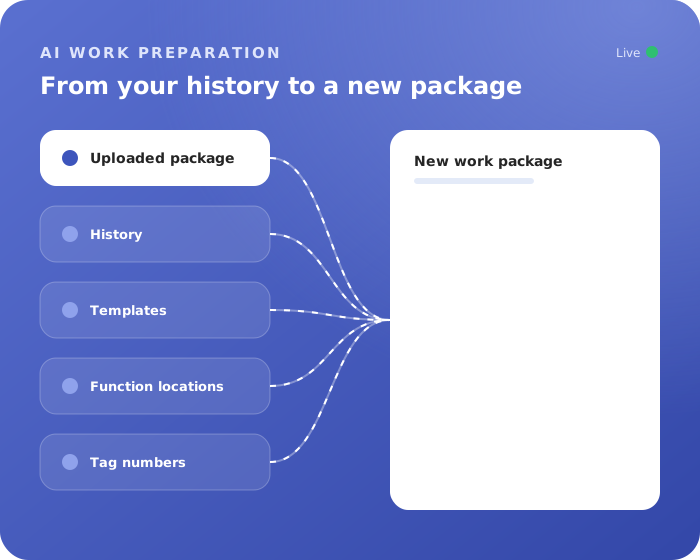
You upload it, and the app reads it. It looks at the technical drawings to see which activities are needed, and works out what kind of work is described, which equipment it concerns and what the package contains. Then it goes looking in your own data for everything that belongs with it: earlier packages with the same kind of work, your templates and standard steps, the relevant function locations and tag numbers, and the hours, resources and materials that were used before.
A complete package in about ten minutes
From all of that, the app builds the new package: activities in a logical order, the resources they need, the materials that go with them and the norm hours, with calculations based on CDO norms. A complete package takes about ten minutes, where building it by hand often takes hours.
Speed is only part of the story. Because every package is built from the same sources in the same way, packages become more consistent. Two work preparers preparing similar jobs end up with comparable packages, using the same templates and the same structure. That makes them easier to check, easier to plan and easier to execute.
Work preparers become reviewers
About 80 to 90 percent of the searching and calculating is done by the app. That does not make the work preparer less important. It changes the job. Instead of copying and typing, they review: does this package make sense for this situation, is anything missing, does the sequence work on site? They adjust where needed and approve.
That is where their experience adds the most value. The judgement stays with the people who know the plant; the copying work does not. For many teams that also means they can keep up with the volume a turnaround brings, with less need for extra contract work preparation.
Your data stays yours
An AI tool is only as good as the data it draws on, and that data is valuable. That is why AI Work Preparation runs on Microsoft Power Platform in your own Microsoft tenant, like all our apps. Your packages, history and templates are stored in your environment. There is no new software package to install. Your users need a Power Apps license, and the AI processing runs on Azure, in your own subscription or through ours, depending on what is possible in your organisation.
Part of a bigger picture
AI Work Preparation works on its own, but it really shines as part of the Turnaround Suite. Packages flow into scope management and scheduling, connected to SAP and Primavera P6, and from there into execution in the field. Every finished package adds to the history the app can draw on next time, so each turnaround makes the next one easier to prepare.
See it with your own packages
The best way to judge an app like this is on your own work. In a 30-minute demo we show how it builds a package from one of yours. Book a demo, read more about AI Work Preparation, or calculate what it could save on your next turnaround.